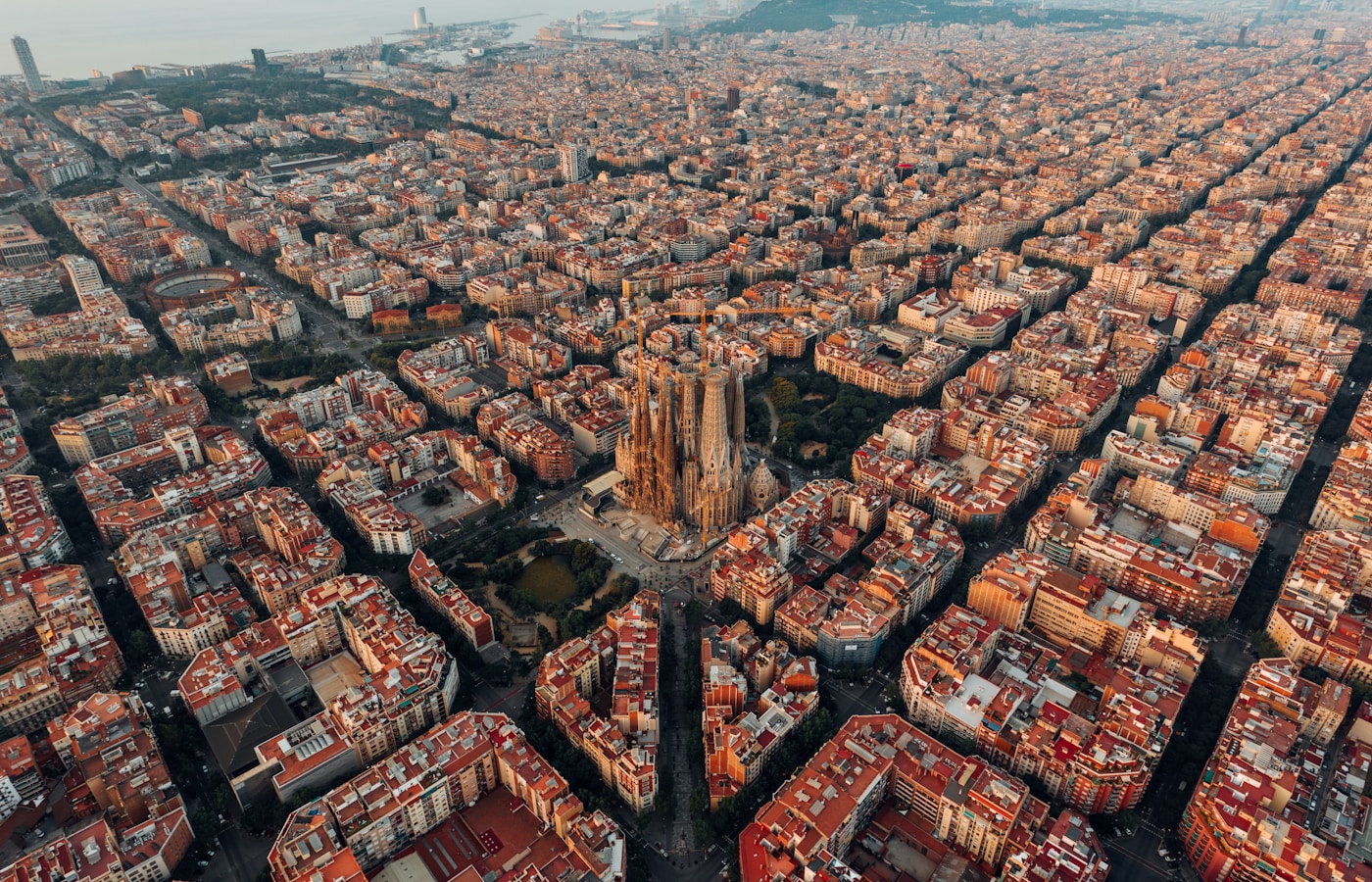
There is no ticket desk at the Sagrada Família. Gaudí's basilica has been under construction since 1882, and its tickets are sold online only. That's the first thing to know about Barcelona: the sights everyone comes for need a booking, and the rest of the city doesn't.
Book these before you go
- Sagrada Família: online tickets only. It's open every day, including Mondays.
- Park Güell: visitor tickets are for time slots between 9:30 and 19:30 (7:30 pm), and you can enter up to 30 minutes after your slot starts. The general ticket is €18 (as of October 2026). The park is open all year.
- La Pedrera (Casa Milà): you choose a visit time when you buy online. It and Casa Batlló, also on Passeig de Gràcia, both open every day.
Why the Gaudí belongs on a Monday
On Mondays the Picasso Museum, the National Art Museum of Catalonia (MNAC), the Fundació Joan Miró, Palau Güell, the city history museum (MUHBA) and the Pedralbes monastery are all closed. The Sagrada Família, Park Güell, Casa Batlló and La Pedrera are open. Give Monday to the Sagrada Família and the two Passeig de Gràcia houses; Park Güell fits any other morning, since it's open every day. Keep the museums for the rest of the week. Two more to watch: MACBA closes on Tuesdays, and the food markets at Santa Caterina and Sant Antoni close on Sundays.
Gothic Quarter and El Born: the old city
The Gothic Quarter is the oldest part of Barcelona, with stretches of the Roman wall still standing. Its cathedral was built from the 13th to the 15th century, with a cloister around the Well of the Geese. In El Born, next door, Santa Maria del Mar was built between 1329 and 1383 in a single, unified Gothic style. On Carrer de Montcada nearby, five medieval palaces hold the Picasso Museum, about 4,251 works, many from his early years. For lunch, the Santa Caterina market is in the same district.
Eixample: the Modernista grid
The Eixample is the 19th-century grid laid out between the old city and the towns around it. Walk up Passeig de Gràcia for Casa Batlló, redesigned by Gaudí from 1904, and La Pedrera, built 1906–1912. The Sagrada Família is at the grid's northeastern edge, and beyond it is the Sant Pau hospital complex by Lluís Domènech i Montaner, built 1901–1930 and, like the Gaudí houses, a UNESCO World Heritage Site.
Gràcia and the hill above it
Gràcia, north of the Eixample, was once one of the separate towns around Barcelona. Park Güell sits on the slope above it. For a view over the whole city, climb on to the Bunkers del Carmel on Turó de la Rovira, a 262 m (860 ft) hill with a Civil War anti-aircraft battery. The museum site there is closed on Mondays, Tuesdays and Thursdays.
Montjuïc and El Raval: the museum hill and the quarter below
Montjuïc is the museum hill. MNAC, above Plaça d'Espanya, is known for its Romanesque church paintings, and the Fundació Joan Miró is on the same hill. Both close on Mondays. Closer in, El Raval, one of the two old quarters beside La Rambla, has MACBA, Barcelona's contemporary art museum, and Gaudí's Palau Güell on Carrer Nou de la Rambla.
Sunday: the waterfront
With both food markets closed on Sundays, it's the day for the sea. Barceloneta Beach is 422 m (1,385 ft) long and one of the city's oldest beaches, popular with visitors from abroad. Inland from it, the Parc de la Ciutadella covers 31 hectares (77 acres) at the edge of the old city, with the zoo and the Catalan Parliament. At the foot of La Rambla, the Columbus Monument marks the port.
La Rambla, honestly
La Rambla is a 1.2 km (0.7 mi) pedestrian street from Plaça de Catalunya to the Columbus Monument at the port. It's crowded, and thieves work it in teams, often with a distraction. A related trick: people posing as police ask to see your wallet. Real officers ask for ID, not wallets. Walk it once, then use the parallel streets. La Boqueria market opens off it near the Liceu opera house.
Getting there
From the airport, the L9 Sud metro leaves from terminals T1 and T2 and reaches the center in about 32 minutes, with one change: to L1 at Torrassa, L5 at Collblanc or L3 at Zona Universitària. The airport stations need an Airport Ticket; a T-casual or a single ticket isn't valid there. The R2 train is the other option. For a day out, the R5 train from Plaça d'Espanya and the rack railway take you to Montserrat, and the R2 Sud train goes along the coast to Sitges.
Plan the rest with the AnnaMundo Barcelona guide: opening days, markets and day trips in one place.
Last checked: October 2026