On March 29, 1858, workers began tearing down the wall around Vienna's old town. In its place the city built the Ringstraße, a 5.2 km (3.2 mi) boulevard that Emperor Franz Joseph opened on May 1, 1865. The wall is gone, but the rings it left still sort Vienna. The old town lies inside the Ring, the big public buildings stand on it, and the old suburbs reach out to a second ring road, the Gürtel. Beyond that are Schönbrunn, the street markets and the wine villages. Plan your days the same way, from the center out.
Inside the Ring: a day on foot
The old town, the Innere Stadt, is small enough to cover on foot. Start at St. Stephen's Cathedral on Stephansplatz, the Gothic cathedral with the multicolored tile roof. You can visit between services, also on Sunday afternoons.
From there, walk to the Hofburg, the Habsburgs' winter palace, first recorded in 1279. The Imperial Apartments, the Sisi Museum and the Silver Collection are open every day. Next to it, the Albertina keeps one of the largest print rooms in the world, about 65,000 drawings and a million old master prints. The State Hall of the National Library is closed on Mondays from October to May.
Break for coffee at Café Central, open since 1876. A coffee house is the old town's living room: you can sit over one cup for a long time.
On the Ring: ride the tram, then get off at the museums
No tram line circles the whole Ring. As of October 2026, line 1 runs along the north and west side, from Schwedenplatz past Schottenring, Börse, Schottentor, Rathausplatz/Burgtheater and Parlament/Volkstheater to Oper/Karlsplatz. Line 2 takes the south and east side, from Oper/Karlsplatz past Schwarzenbergplatz and Stubentor to Schwedenplatz. Ride one, then the other, and you have seen the whole Ring. Lines 71 and D also run the western side, between Schottentor and Schwarzenbergplatz.
Construction work and events on the Ring reroute these lines from time to time, so check Wiener Linien before you ride. Validate your ticket before you travel or as soon as you board.
From the window you pass the buildings the Ring was made for. The State Opera, built from 1863 to 1869, was the first big one; guided tours show the house by day. The Parliament and the City Hall followed in the 1870s and 1880s, with the Burgtheater and the University's main building between them. The Kunsthistorisches Museum and the Natural History Museum, both built from 1871 to 1891, face each other across Maria-Theresien-Platz. The Kunsthistorisches Museum, Austria's largest art museum, is open every day. Its twin is closed on Tuesdays.
Between the Ring and the Gürtel: markets and the Belvedere
The Gürtel follows the line of Vienna's second, outer wall, the Linienwall of 1704, which came down from 1873. It encloses the old suburbs, now districts 3 to 9. This is where Vienna shops and eats.
The Naschmarkt runs for about 1.5 km (0.9 mi) along the Wienzeile, stalls and small restaurants with fruit, vegetables, cheese and bread. Its stalls are open Monday to Saturday, and on Saturdays a flea market joins it. The U4 stops at Kettenbrückengasse, at the market's far end. Nearby, the Secession is closed on Mondays, and the Karlskirche on Karlsplatz takes visitors with a ticket Monday to Saturday. The MuseumsQuartier, the former imperial stables, opened in 2001 as an arts complex; its courtyards are open around the clock.
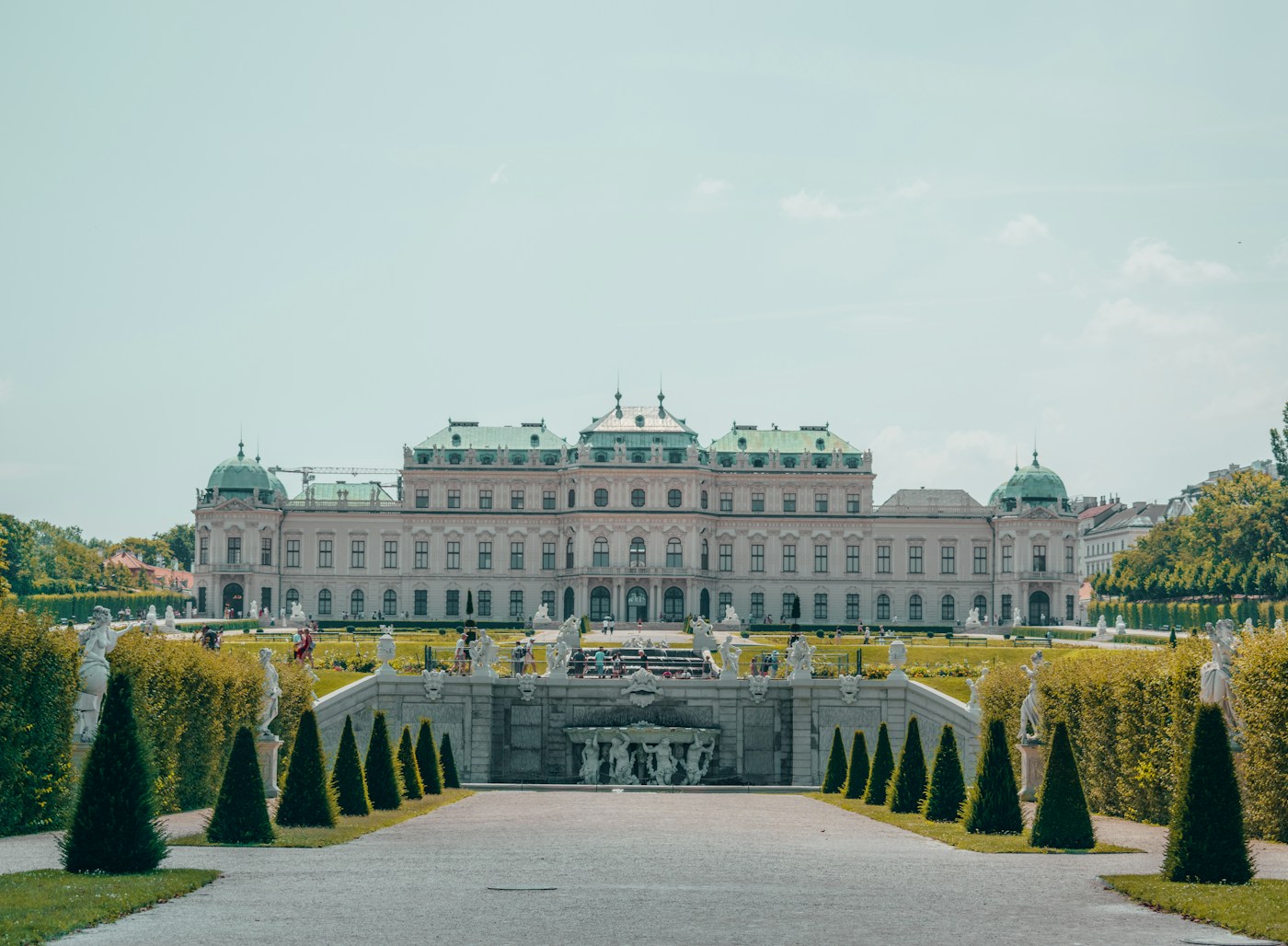
The Belvedere is two Baroque palaces built for Prince Eugene of Savoy, with a formal garden between them. The Upper Belvedere, home of Klimt's The Kiss, is open every day. Tram D stops at Schloss Belvedere, and line 71 at Unteres Belvedere.
Across the Danube Canal, line 1 continues from Schwedenplatz to the Prater, a 6 km² (2.3 sq mi) park in Leopoldstadt. Its Giant Ferris Wheel was built in 1897 and runs all year.
Beyond the Gürtel: Schönbrunn, a street market and the wine taverns
Schönbrunn Palace lies in Hietzing, the 13th district, on the U4 (stops Schönbrunn and Hietzing). The Habsburgs' summer residence has 1,441 rooms and is open every day. Palace tickets are sold for time slots, which can sell out, so the palace recommends booking online. Its park is free to walk in during opening hours. The gates open at 6:30 (6:30 am) and close between 17:30 (5:30 pm) in winter and 21:00 (9 pm) from May to August. Schönbrunn Zoo, founded in the park in 1752, is the oldest zoo still in operation and is open every day of the year.
The Brunnenmarkt in Ottakring is Vienna's longest street market, held there since 1786. Around 40 to 50 stalls open on weekdays and up to 120 on Saturdays, with farmers on Fridays and Saturdays. Tram 2 stops at Brunnenmarkt.
On the city's edge, winemakers serve their own wine in Heurigen, wine taverns. A genuine one serves only wine from its own vineyards and marks itself with a bunch of pine branches and a sign saying "Ausg'steckt", which also shows when it is open. Many are open all year, but smaller ones open only on set dates, so check the tavern's website. They may serve cold dishes and their own drinks; some also have a licence for a hot buffet. Tram 38 ends in Grinzing, and tram D ends in Nussdorf, two of the classic wine villages.
Past the last ring: west to Salzburg and the Alps
ÖBB trains run from Vienna to Salzburg twice an hour without changes. The fastest, the Railjet Xpress, takes 2 hours 25 minutes. Salzburg is where AlpineSpot's road trip through Austria's Alps begins: Salzburg to Innsbruck in four legs, via Hallstatt and the Grossglockner road.
Getting there and around
From Vienna Airport, Railjet and Intercity trains run to Wien Hauptbahnhof in about 15 minutes, twice an hour. In the city, the U-Bahn and the trams cover every ring in this post: the U4 for the Naschmarkt and Schönbrunn, trams 1 and 2 for the Ring, D and 38 for the wine villages. Tickets and current fares are on the Wiener Linien ticket page.
Start your first morning on tram 1 or 2: the Ring shows you where everything else is.
Last checked: October 2026