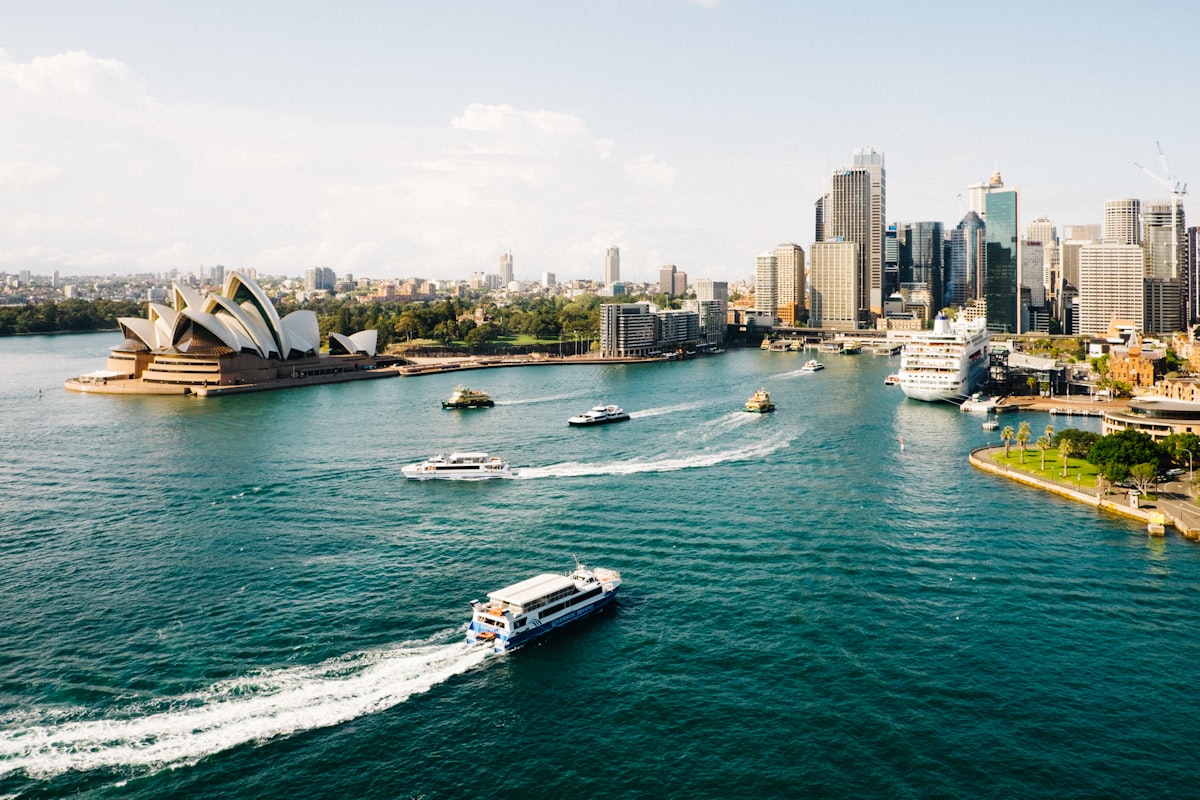
Sydney is a harbor city: its best days are spent on a ferry deck or on the cliff path between beaches. Melbourne is a walking city: its best days are spent in laneways, arcades and inner suburbs. They're about 880 km (550 mi) apart by road, and on a short trip you may only have time for one.
Sydney: plan around the water
Start at Circular Quay and take the F1 ferry to Manly. It's a regular public ferry, so you tap on and off with an Opal card or a contactless card. For seven nautical miles it passes the Opera House and the Harbour Bridge, heads east toward the Heads, then turns north past Sydney Harbour National Park to the beach suburb of Manly.
On another day, walk from Bondi to Coogee. The coastal path is 6 km (3.7 mi) one way and takes two to three hours, depending on how often you stop. It passes Tamarama, Bronte, Clovelly and Gordons Bay, with some steep stairs, especially around Gordons Bay. In winter, look out for humpback whales from Bondi.
One honest note: rip currents are the main hazard on Australian beaches. Bondi is patrolled by lifeguards all year. Swim between the red and yellow flags, where the lifeguards can see you.
Melbourne: slow down and walk
Melbourne's center is best on foot. The City of Melbourne's own arcades and lanes walk is about 4 km (2.5 mi) and takes around two hours. It starts in Degraves Street, across from Flinders Street Station, with its street art and cafés, and continues through Centre Place, a tiny alley of cafés, bars and small shops. It also takes in the Block Arcade, with its 1893 glass canopy and mosaics, and the Royal Arcade of 1870, Australia's oldest shopping arcade.
When your feet give out, the trams in the city center are free. You don't need a myki card for trips that start and end inside the Free Tram Zone, and you shouldn't tap on. As soon as a trip starts or ends outside the zone, you need a myki.
Then go out to Fitzroy, Melbourne's first suburb. Brunswick Street runs north through it from Victoria Parade at the edge of the center, and Gertrude Street is considered the most historically significant strip in urban Aboriginal Victoria. Smith Street divides Fitzroy from Collingwood.
Plan the Queen Victoria Market around its days. It's open Tuesday and Thursday to Sunday, so not on Mondays or Wednesdays. As of October 2026, it opens at 06:00 (6 am), on Sundays at 09:00 (9 am), and closes at 15:00 (3 pm) Tuesday to Friday and 16:00 (4 pm) on weekends.
Melbourne sits between Australia's hot, dry interior and the cold Southern Ocean. When a cold front moves in, the Bureau of Meteorology says everything can change within minutes: temperatures drop, clouds roll in, and rain and sometimes thunderstorms follow. Pack a layer even on a hot morning.
Getting between the two
- Fly: about 1½ hours.
- Train: NSW TrainLink runs from Sydney Central to Melbourne Southern Cross, a morning and an evening departure, in a little under 11 hours. Booking ahead is recommended.
- Drive: 879 km (546 mi) on the inland route. Albury Wodonga, on the Murray River, is about 5½ hours from Sydney and 3½ from Melbourne. The coastal route is 1,030 km (640 mi).
When to go
The seasons are the reverse of Europe's and North America's: summer is December to February, winter June to August. In Sydney, the long-term averages are 26 °C (79 °F) by day and 19 °C (66 °F) at night in January, and 16 °C (62 °F) and 8 °C (47 °F) in July. Melbourne is as warm by day in January, 26 °C (79 °F), but cooler at night, 14 °C (58 °F), and colder in July, 14 °C (56 °F) by day and 6 °C (43 °F) at night. Sydney's ferries and coastal walk run all year, and Bondi is patrolled all year. Melbourne's laneways, arcades and trams don't depend on the weather, as long as you bring that extra layer.
If you only have time for one
Pick Sydney if you want to be outdoors: ferries, a coastal walk and a swim between the flags. Pick Melbourne if you'd rather walk a city slowly: laneways, a market morning and an afternoon in Fitzroy.
Plan the details with the AnnaMundo guides to Sydney and Melbourne.
Last checked: October 2026